The Wartime CEO: How Economic Shocks Reshape Corporate Leadership
In the corporate world, the term “wartime CEO” is often used to describe a leader who can make the cold, calculated decisions necessary to save a company during a crisis. While we often think of these shifts as a matter of skill, groundbreaking research suggests the transformation is actually psychological.
The Practitioner “So What”
Leadership “fit” is dynamic, not static. Boards must recognize that a “prosocial” leader who drives high morale during growth may become psychologically ill-suited for periods of contraction. Strategic survival often requires matching the CEO’s psychological profile to the current economic “climate.”
The Research: Psychology of the CEO-Firm Match
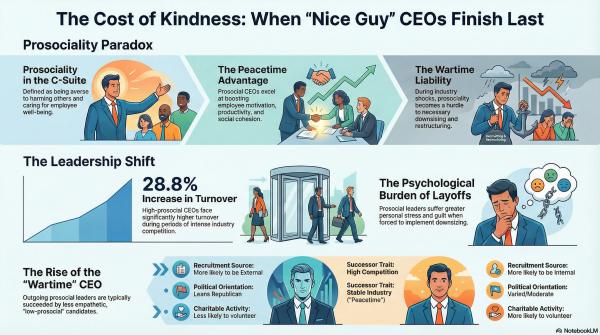
Keum and Bhatia (2025) explored “prosociality”—a trait characterized by deep concern for employee welfare. While prosocial CEOs boost morale in stable times, this trait becomes a strategic burden during downturns. The researchers used the “China shock”—increased import competition—to see how firms requiring aggressive downsizing handled leadership transitions.
Key Findings
The Cost of Compassion
The Turnover Trigger
The “Wartime” Successor
Practical Implications
Guidance for Boards & Executives
- Personality as Strategy: Retention should depend on the fit between a leader’s personality and the firm’s immediate needs as much as professional skills.
- Re-evaluate Alignment: Boards should periodically re-evaluate the psychological alignment of their leadership with the current macroeconomic environment.
- Survival Priority: As global competition intensifies, firms may see a systemic shift toward prioritizing “wartime” survival over “peacetime” motivation.
Conclusion: Leadership Fit as an Economic Outcome
The idea of the “wartime CEO” is often framed as a matter of toughness or temperament, but the evidence presented by Keum and Bhatia (2025) suggests something deeper and more systematic is at work. Economic shocks do not merely change firm strategies; they reshape who is able, willing, and permitted to lead. Prosociality, a trait long celebrated for its role in building commitment and trust, can become a liability when firms face pressures that demand painful retrenchment. In these moments, leadership turnover reflects not failure, but a breakdown in psychological fit between the leader and the firm’s economic realities.