

Hosted by the Global Strategy Interest Group
This webinar brings together leading scholars to explore how artificial intelligence is reshaping international business and global strategy. As AI transforms how firms compete, organize work, manage talent, and expand across borders, it also raises important new research questions. The discussion will examine what AI means for global strategy, how it is changing the geography and management of talent, and what emerging research is teaching us about firms operating in an increasingly technology-driven world.
Free for members | $39 for non-members
Can’t attend live? We still encourage you to register — you’ll be among the first to receive the session recording once it’s released.
Speakers
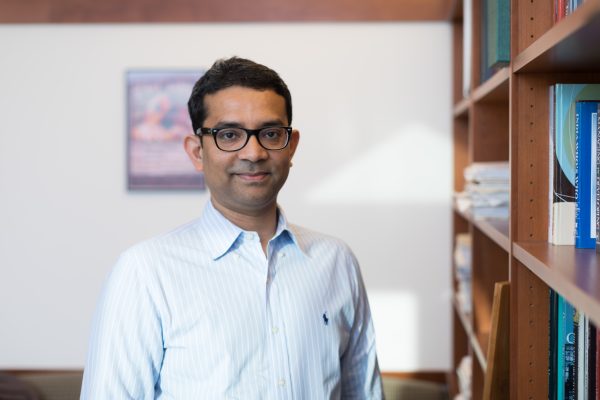 Prithwiraj (Raj) Choudhury is a Professor of Organization Behavior in the Management Department at the London School of Economics and Political Science (LSE) and a globally recognized expert on the Future of Work. Prior to LSE, he served on the faculties at Wharton and Harvard Business School. In 2023, Forbes included him in their Future of Work 50 list, and in 2024 he was included in the TIME-Charter 30 list of thought leaders shaping the future of work. He is also an Associate Editor at Management Science and Strategic Management Journal and incoming co-Editor in Chief at Journal of Organization Design. Raj studies how technology is changing where we work and how we work and has pioneered research on how ‘Work from anywhere’ (WFA) affects workers, organizations, communities, and smaller towns. He also studies the impact of AI on organizations and how AI, automation and Digital Twins can help both desk workers and deskless workers work from anywhere. Prior to academia, he worked at McKinsey & Company and Microsoft, obtained his doctorate from Harvard and earned degrees from the Indian Institute of Technology Kharagpur and Indian Institute of Management, Calcutta.
 Thomas Lindner is a professor of international business with affiliations at Copenhagen Business School, the University of Innsbruck, and WU Vienna. In his research, Thomas works on understanding how companies make business decisions, with a focus on the global political environment, the role of artificial intelligence, and company finances. His research predominantly uses quantitative methods, and Thomas has contributed to developing such methods in the context of editorials, perspective papers, and special interest groups. In his policy-oriented work, Thomas works together with central banks and governments to improve data-driven decision-making as well as the education of gifted students. In his work oriented towards business practice, Thomas advises companies on internationalization strategies, the valuation of acquisition targets, and on developing measurement systems for social impact. Outside work, Thomas enjoys skiing, beach volleyball, reading science fiction, and travelling the world.
 Patricio Duran is an Associate Professor of Management and International Business and Academic Program Director for Graduate Programs at the Robins School of Business, University of Richmond. He also serves as Representative-at-Large for the Global Strategy Interest Group of the Strategic Management Society. His research examines the intersection of global strategy, corporate governance, institutions, and corporate entrepreneurship, with particular attention to emerging markets and institutionally complex environments. He has published in leading management and international business journals, including the Academy of Management Journal, Journal of International Business Studies, Journal of Management, Journal of Management Studies, Global Strategy Journal, and Entrepreneurship Theory and Practice. His work has received several international recognitions. At the University of Richmond, he leads international learning experiences and consulting-based projects that connect students with firms addressing real global expansion challenges, including the development and internationalization of AI-based business models from emerging to developed markets.