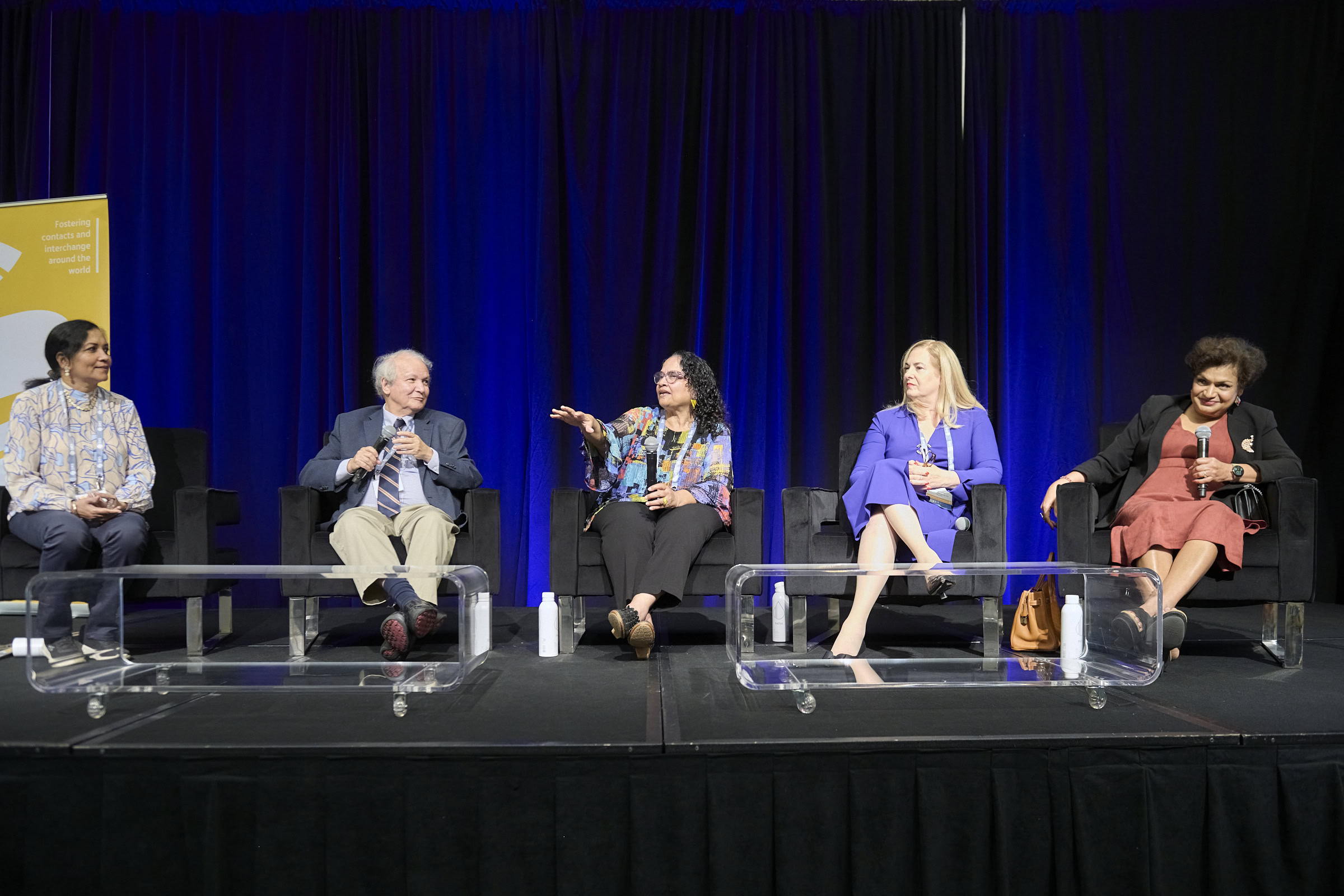
Plenary Sessions at SMS Hong Kong
Plenary Sessions bring all attendees together for inspiring keynotes, dynamic panels, and engaging fireside chats featuring leading scholars and industry practitioners. These main-stage conversations explore timely topics at the intersection of research and real-world strategic impact.
Click below to learn more about the Plenary Sessions taking place at the SMS Special Conference in Hong Kong.
Sunday, June 28, 2026 from 9:45 - 10:30
Panelists:
- Dr. Kelvin Wong, Chairman of HKSFC
- Prof. Jay Barney, University of Utah
- Prof. Jonathan Bundy, Arizona State University
Sunday, June 28, 2026 from 10:45 - 11:45
Panelists:
- Augusto King, MUFG Securities Asia Limited
- Olivia Wong, MTR Corporation Limited
- Jennifer Tan, Ant Group
- Webster NG, Hong Kong Special Administrative Region of the People's Republic of China
Moderator: Robert Park, Professor of Practice, Hong Kong Polytechnic University
Stakeholder governance has emerged as an important framework for understanding corporate responsibility and organizational effectiveness, given the increasing complexity and interdependence in the business world. This panel will share cases of successful and unsuccessful stakeholder governance practices across industries, providing valuable insights into the factors that drive effective stakeholder management. Through this discussion, this panel seeks to equip practitioners and scholars with actionable strategies to enhance stakeholder engagement, foster collaboration, and ultimately drive organizational success in an increasingly interconnected world.
Sunday, June 28, 2026 from 12:45 - 13:30
Keynote Speaker: Witold Henisz, University of Pennsylvania
Stakeholder governance is often misread as managerial indulgence, constitutional enfranchisement, or a distraction from markets. I argue that Freeman’s deeper contribution was relational: firms create value in markets through their relationships with stakeholders whose cooperation cannot be fully owned, priced, or contracted for. Beyond markets, hierarchies, and constitutions lie stakeholder governance mechanisms that shape ex post behavior: purpose, relational capital, probity, stakeholder evaluation, and social sanction. These mechanisms lower transaction costs, support adaptation, strengthen probity, and make opportunism visible and sanctionable. This view stands against a market-sovereignty alternative that elevates property rights, prices, shareholder returns, and entrepreneurial judgment while underestimating unpriced externalities, polarization, and institutional fragility. In an era of climate crisis and democratic strain, advancing theoretical and empirical work in stakeholder governance is not sentimentality nor a holdover from a has-been fad; it is a strategic imperative if capitalism is to pass its probity test.
Sunday, June 28, 2026 from 15:35 - 16:35
Panelists:
- Jay Barney, University of Utah
- Peter Klein, Baylor University
- Ruth Aguilera, Northeastern University
- Cuili Qian, University of Texas at Dallas
Moderator: Heli Wang, Singapore Management University
This panel explores the macro issues surrounding stakeholder governance, focusing on its implications for businesses, policymakers, and society at large. It will examine the evolving role of stakeholders in shaping corporate strategies, emphasizing the interplay between shareholder interests and broader societal concerns. Key topics will include the challenges of balancing diverse stakeholder demands, the impact of regulatory frameworks on governance practices, and the influence of global economic trends on stakeholder engagement. Additionally, it will address the ethical considerations inherent in stakeholder governance, particularly in the context of environmental sustainability, social justice, and corporate accountability. Panelists will share insights on best practices for fostering inclusive governance structures that not only enhance organizational resilience but also contribute to sustainable development. Through critical dialogue, this panel seeks to illuminate the complexities of stakeholder governance and propose actionable strategies for organizations navigating the multifaceted stakeholder relationships.
Monday, June 29, 2026 from 8:30 - 9:15
Keynote Speaker: Edward Freeman, University of Virginia
The purpose of this paper is to analyze a number of issues that arise as the discipline of strategic management begins to take stakeholder theory seriously. We begin by explicating a view of stakeholder theory that has been developed by pragmatist theorists, and we differentiate this approach from other interpretations. We then suggest that there are philosophical, ethical and methodological issues that define a number of tensions between stakeholder theory and traditional strategic management scholarship. Finally, we suggest a number of rather different research questions that can be framed by combining the 50 years of research on stakeholder theory with strategic management.
Tuesday, June 30, 2026 from 8:30 - 9:15
Keynote Speaker: Anita McGahan, University of Toronto
The turn toward the new stakeholder theory that we took about five years ago has generated new descriptive insights about who is engaged by an organization in the creation and capture of value through orchestrated action. In this talk, Anita will talk about when stakeholder engagement is willing, non-willing, unwilling, and about why this matters for governance of organizations. Focusing on the complexities of stakeholder governance opens up new questions for theory, empirical research, and policy that extend well beyond what we have customarily considered through the lens of stakeholder analysis.
Tuesday, June 30, 2026 from 15:10 - 16:10
Panelists:
- Don Lange, Arizona State University
- Russ Coff, University of Wisconsin-Madison
- Flore Bridoux, Erasmus University
- Donal Crilly, London Business School
Moderator: Nicolai Foss, Copenhagen Business School
This panel explores the micro-level dynamics shaping stakeholder interactions and decision-making. It focuses on nuanced issues of stakeholder governance, highlighting the practical challenges organizations face and the strategies they use to engage stakeholders effectively. Core topics include stakeholder identification and prioritization; power dynamics and conflicts of interest; communication and relationship management; and individual-level motivations, cognitions, behaviors, and interactions influenced by broader governance structures and processes. Recognizing the inherently interdisciplinary nature of micro-level stakeholder research, the panel will also address related theoretical and empirical challenges. Through critical dialogue, it seeks to clarify links between micro- and macro-level perspectives on stakeholder governance.