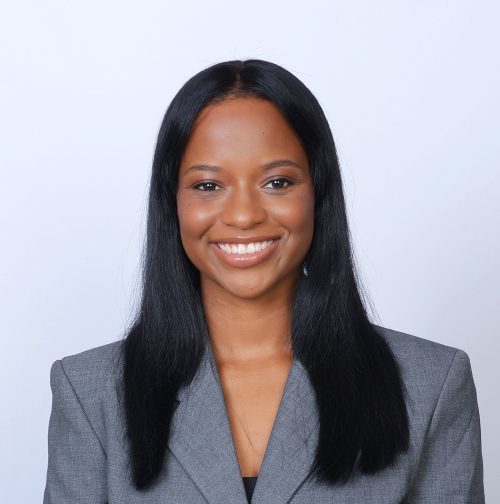
Trissanne Keen of University of Michigan was a recipient of the 2025 Will D. Mitchell Dissertation Research Grant program. Learn more about Trissanne’s work:
What is your research question/topic?
How do employees evaluate firms whose actions simultaneously generate societal benefits and harms, and how does perceived authenticity shape those evaluations, effort, and wage expectations?
What are you hoping to accomplish through your research?
Through this research, I hope to clarify how employees make sense of firms whose core activities create both societal benefits and societal harms, and why those interpretations matter for strategy.
Many firms today operate in morally complex environments where technologies associated with sustainability, innovation, and economic growth are also linked to social and ethical costs embedded in global supply chains. My goal is to move beyond treating these firms as simply “good” or “bad,” and instead offer a framework that captures how different combinations of benefits and harms shape employee perceptions.
In particular, I aim to show that employees’ responses depend not only on what firms do, but on whether they perceive firms as acting authentically by aligning their stated values with their actual practices across the value chain. By clarifying when authenticity strengthens or undermines employee evaluations, discretionary effort, and wage expectations, this research seeks to illuminate how firms build or erode sustained human capital advantage in an era of heightened attention to climate change, the clean energy transition, and responsible supply chains.
What impact could this research have more broadly on the field of strategic management?
More broadly, this research contributes to strategic management by showing how firms’ societal impact shapes the role of authenticity and human capital in generating competitive advantage. By moving beyond a simple “good versus bad” view of societal impact, the study highlights how different combinations of societal benefits and harms create distinct strategic contexts that employees interpret in meaningful ways.
Centering employees in this process, the research bridges stakeholder theory and strategic human capital by showing how moral judgments shape evaluations, discretionary effort, and wage expectations under heightened social scrutiny. It also advances research on authenticity by clarifying how the alignment between values and practices operates differently across morally complex strategic contexts.
What SMS resources (members, workshops, events, etc.) were helpful to you during the application process?
During the application process, I primarily relied on the guidance and materials provided on the SMS website, including the SRF application guidelines. After learning about the opportunity through my department, I requested a letter of recommendation from my advisor and focused closely on ensuring that my application materials aligned with the goals of the SRF program. While I did not participate in formal SMS workshops or events during the application period, the clarity of the SRF materials made it possible to complete the application successfully.
Who inspires you the most to do this work? (whether that is professionally or personally).
I am inspired first and foremost by my family. They are the people I care about most, and they motivate me to pursue work that is meaningful and purposeful. My faith is also an important part of this foundation. It shapes how I think about responsibility, humility, and service, and it guides not only what I choose to study, but how I try to approach my work and relationships with others.
I am also inspired by a desire to do research that matters for people. By focusing on societal impact, I am able to study questions that connect firms’ strategic decisions to real human consequences. As someone of Afro-Caribbean heritage who has spent time in Africa, I am especially motivated to bring attention to populations and contexts that are often absent from strategic management research. My work seeks to highlight how upstream processes, such as those in the Democratic Republic of the Congo, connect to downstream outcomes related to climate change, the clean energy transition, and sustainable innovation.
Finally, I am inspired by the field of strategic management itself and by the scholars around me. Beginning with my department at the University of Michigan’s Ross School of Business, I have been shaped by mentors and colleagues who exemplify careful, rigorous, and purpose-driven scholarship. Their commitment to thoughtful, causal, and process-oriented research has strongly influenced my aspiration to contribute work that is both analytically rigorous and socially meaningful.