
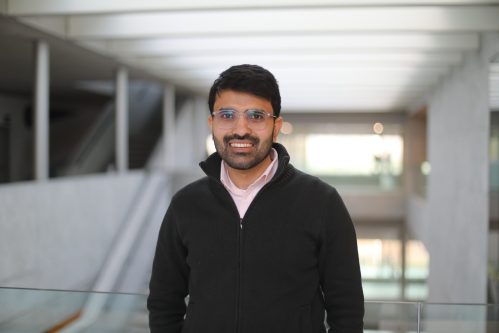
Rohin Vrajesh of Bocconi University was a recipient of the 2025 Will D. Mitchell Dissertation Research Grant program. Learn more about Rohin’s work:
What is your research question/topic?
Prior research has shown that expanded access to scientific data can have a democratizing effect by enabling research participation and outputs among researchers with fewer resources. Building on this insight, my research asks how large-scale public scientific information releases affect firms’ strategic allocation of R&D effort, and why reductions in scientific uncertainty lead to strategic rebalancing across disease areas rather than uniformly expanded investment. I focus on cancer genome mapping initiatives as a large-scale public information shock and study their effects on clinical trial activity across rare and common cancers, using variation in firm experience and scientific human capital to analyze heterogeneous responses.
What are you hoping to accomplish through your research?
This research aims to identify the organizational and strategic mechanisms through which firms interpret and act on reductions in scientific uncertainty generated by public data initiatives, using evidence from R&D entry and continuation decisions. By examining how firms adjust R&D entry and continuation decisions following large scale information releases, the study explains persistent differences in research investment across disease areas, including the continued underrepresentation of rare diseases. The goal is to generate evidence on the strategic and organizational factors that shape these outcomes, thereby informing policy discussions on how public scientific investments can be designed to more effectively direct private innovation toward socially valuable but persistently neglected domains.
What impact could this research have more broadly on the field of strategic management?
This research advances strategic management by reframing how scholars understand the strategic consequences of large-scale public information releases. Rather than treating expanded data access as inherently equalizing, the study highlights how uncertainty reduction operates through firms’ existing organizational structures and strategic decision-making processes. In doing so, it shifts attention from information availability alone to the ways in which firm-level differences shape how new knowledge is interpreted, absorbed, and acted upon. More broadly, the research contributes to theories of innovation strategy and resource allocation under uncertainty by clarifying how informational shocks, conditioned by organizational differences, influence the distribution of innovative activity across domains.
What SMS resources (members, workshops, events, etc.) were helpful to you during the application process?
The application benefited greatly from feedback provided by my advisors, Andrea Fosfuri and Aldona Kapacinskaite, as well as from guidance offered by former WMDRG recipients during the proposal development process.
Who inspires you the most to do this work? (whether that is professionally or personally).
I am deeply driven by concerns about inequality in how scientific progress translates into societal benefit, particularly in healthcare. Despite substantial public investment in scientific research and data infrastructure, many diseases, especially rare conditions, continue to receive limited and uneven research attention. Observing this disparity has shaped my interest in understanding how firms’ strategic decisions influence which patient populations ultimately benefit from advances in science. I am especially compelled by the possibility that even well intentioned and widely accessible scientific resources, such as open genomic data, may unintentionally reinforce existing inequalities once they interact with firms’ strategic choices and human capital. This research looks at how firms’ decisions affect whether public investments in science actually lead to benefits for patients, and why some diseases continue to receive less research attention than others. Understanding this disconnect between public spending and real-world outcomes is the core motivation for my work.