
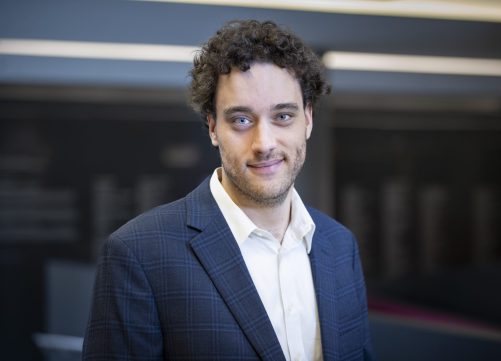
James Addis of University of Toronto was a recipient of the 2025 Will D. Mitchell Dissertation Research Grant program. Learn more about James’ work:
What is your research question/topic?
An emerging conversation in innovation strategy highlights the importance of different ‘applications’ or ‘uses’ for technology. However, the field is only beginning to explain how and why firms strategically choose to pursue particular applications over others. Complementing recent work on internal drivers and processes, this paper focuses on external factors. I hypothesize that firms are more likely to pursue a specific application of a technology after observing salient events – such as large funding rounds or acquisitions – experienced by peers commercializing the same technology. I construct a novel longitudinal dataset mapping the product market applications of emerging technologies pursued by US-based startups, utilizing a large language model to analyze archived firm websites. I find that a focal firm is significantly more likely to diversify or pivot into a particular product market application following salient positive events for other startups active in the same technology. This association is moderated by founder prior experience and levels of competition. Together, these results point towards a phenomenon of collective experimentation, whereby the strategic choice of technology application is driven not only by private information, but by a social process of mutual observation and validation.
What are you hoping to accomplish through your research?
I hope my research is a helpful puzzle piece in the broader big picture about the importance of different ‘applications’ or ‘uses’ for technology. This issue is not only relevant to the academic field of strategy, but is also important to real-world managers and policymakers. We live in a world where everyday individuals, firms, and policymakers must reckon with powerful emerging technologies that may be applied to a variety of uses – perhaps most notably, artificial intelligence. How do firms choose which use(s) to pursue over time? Do they prefer those recently validated by peer success, or do they explore a wide range of potentially viable uses? Overall, which uses become popular? How? Questions like these matter not only for value creation and capture efforts by established firms and startups commercializing these multi-application technologies, but also for understanding the current and future social and economic impact of the technologies (which occurs through their deployment towards various uses).
What impact could this research have more broadly on the field of strategic management?
This research contributes to the field of strategic management in several respects. First and foremost, it improves our understanding of the strategic antecedents and consequences of different applications for technology. Thus, it forwards the emerging conversation in the technology and innovation strategy literature amongst scholars studying related phenomena such as exaptation and general purpose/enabling technologies. There is so much room for theoretical and empirical work in this exciting, growing area of research; I hope my research project helps stimulate research in this area by other scholars. Second, my research studies the changing product market activity and positioning of startups over time, which is relevant to the boom of recent interest in strategy and entrepreneurship about pivoting and experimentation. Third, this research project is one of only a few recent projects to demonstrate how archived website text can be leveraged to measure positioning changes over time; there is a significant opportunity for other strategy scholars to utilize this data source to answer new, important questions and offer new empirical evidence on well-known ‘classic’ questions.
What SMS resources (members, workshops, events, etc.) were helpful to you during the application process?
My experiences at SMS events and workshops – as well as interactions with SMS members in other contexts – have had a significant impact on my research project and on my overall scholarly development. My attendance at a variety of sessions at SMS annual meetings in 2023 in Toronto and 2025 in San Francisco were helpful in educating me about the current research frontier in my areas of interest and creating situations where I could make connections with both fellow PhD students and established professors in the field. I also participated in the 2025 SMS Doctoral Workshop, a valuable opportunity for me to further develop as a scholar: I learned from the interesting presentations by senior SMS members, received helpful roundtable feedback on an early version of my WMDRG research project, and networked with fellow PhD students.
Who inspires you the most to do this work? (whether that is professionally or personally).
On both a personal and professional basis, my greatest inspirations for my research are my advisors Brian Silverman and Anita McGahan. Not only have they always conducted research that is stimulating and relevant to the frontier of the field of strategy, their work is also true to their personal research interests, thought-provoking, creative, and highly rigorous. I can only aspire to follow their examples – in this research project, and in my career as a whole. I also deeply admire their everyday behavior towards colleagues and students. Deeply knowledgeable about the field, Brian and Anita are receptive and open-minded towards a wide variety of research in strategy, engaging actively with work originating from different disciplinary backgrounds, on different topics, and using different research methods.