
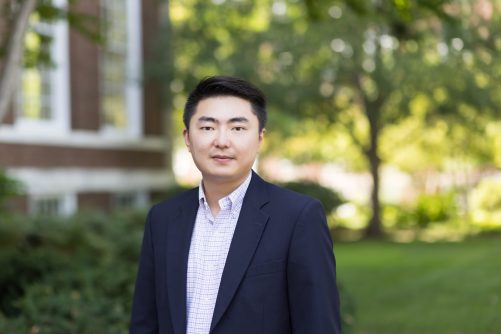
Haiyang Zhang of Harvard Business School was a recipient of the 2025 Will D. Mitchell Dissertation Research Grant program. Learn more about Haiyang’s work:
What is your research question/topic?
My dissertation examines how firms adapt their boundaries and scope when strategic choices are constrained rather than freely adjustable. Across projects, I study how ownership, institutions, and geography reprice strategic trade-offs in settings where markets and prices alone do not fully coordinate outcomes.
The focal project asks: when firms face severe climate shocks, do they persist in established geographic clusters or reconfigure their footprint through geographic dispersion—and why? The project investigates how firms balance the competing pressures of agglomeration benefits and climate risk by analyzing the degree of interdependence with local labor markets and suppliers as well as the breadth and readiness of a firm’s multi-site network. Together, these factors shape firms’ strategic responses to non-negotiable physical constraints.
What are you hoping to accomplish through your research?
Through this SRF-supported research, I aim to show how climate shocks reprice the strategic trade-offs that govern firms’ boundaries and geographic scope. By observing how firms adjust their footprint after severe climate events, the study speaks directly to a potential tension in theory, where the pull of agglomeration favors geographic concentration, and the real options logic emphasizes dispersion to preserve flexibility under uncertainty.
The study introduces new measures to observe location and scope decisions at the facility level, where performance is generated, rather than relying on firm-level aggregates. It seeks to clarify when geographic scope functions as a commitment to co-specialized local assets and when it operates as a flexible option that firms can actively exercise. A broader objective is to connect strategic theory with micro-level evidence that informs managerial decision-making under non-negotiable physical constraints.
What impact could this research have more broadly on the field of strategic management?
I hope this research can contribute to strategic management in three ways. First, it brings agglomeration economics and real options theory into direct empirical conversation, clarifying when and why each logic dominates firms’ strategic choices under constraint.
Second, the study treats a firm’s location strategy as a core boundary decision rather than peripheral risk management, demonstrating how non-negotiable physical constraints can reshape firms’ scope, commitments, and sources of advantage. By moving analysis below firm-level aggregates, it shows how classic debates about concentration versus dispersion and commitment versus flexibility play out where performance is actually generated.
Third, the study demonstrates how micro-level data can inform and extend classic questions. As climate risk becomes increasingly salient for firms, investors, and policymakers, the study could offer a framework for understanding how non-negotiable physical constraints reprice strategic trade-offs. In doing so, the research provides guidance on when firms should invest in resilience within place-based assets and when geographic reconfiguration is likely to be the more effective strategic response.
What SMS resources (members, workshops, events, etc.) were helpful to you during the application process?
The Strategic Management Society has been central to my development as a scholar. Feedback from SMS conference presentations, doctoral workshops, and informal conversations with SMS members helped sharpen both the theoretical framing and empirical design of the study. In particular, engagement with faculty and peers at SMS doctoral workshops encouraged me to articulate more clearly how constraints shape strategic choices. The Will Mitchell Dissertation Research Grant extends this intellectual community, and I am grateful for the Society’s continued investment in early-career scholars.
Who inspires you the most to do this work? (whether that is professionally or personally).
My advisor, Juan Alcácer, has been instrumental in shaping how I approach questions of firm boundaries and location strategy. The rest of my committee—Shane Greenstein, Dennis Yao, Maria Roche, and Arkadiy Sakhartov—have inspired me through their commitment to rigorous, impactful research and their generous mentorship. I have also learned enormously from teachers like Jay Barney and Eric Van den Steen, as well as from my coauthors, who continue to push me to think more deeply and clearly.
On a personal level, I am driven by the managers and leaders whom I worked with earlier in my career. Their choices carry profound consequences for their organizations and society. I also owe a debt to my teachers from the past. Ken Elzinga kindled a scholarly pursuit in me and showed me that ideas can matter beyond the classroom.