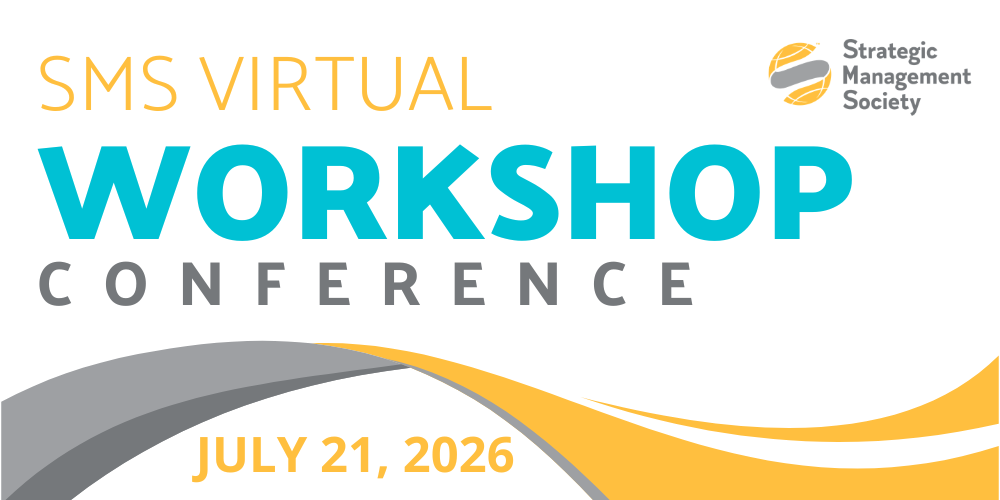
The SMS Virtual Workshop Conference was a new online event designed to bring the SMS Conferences workshop experience to a global audience. Modeled on the popular Saturday Workshop program at the Annual Conference, the virtual event offered participants hands-on opportunities to strengthen their research and professional skills through focused, application-based sessions with experienced facilitators and thought-leading panelists.
Participants joined 120-minute workshops designed to foster meaningful interaction, collaboration, and personalized feedback, along with a live plenary session that brought all attendees together for shared insights and community connection. With an accessible virtual format, this event was perfect for members who could not attend the Annual Conference in person or those who wanted more interactive learning and development opportunities without the hassle of travel.
Conference Program Chairs
Elizabeth L. Rose, ICFAI Foundation for Higher Education (IFHE)
PK Toh, Nanyang Business School, Nanyang Technological University (NTU)
Meeting Date
July 21, 2026, 2026
Meeting City
Virtual
WANT TO LEARN MORE?
Take a quick peek at our event recap to catch up on all the exciting moments from our recent gathering!
Workshop Co-Organizers:
- Mahka Moeen, University of Wisconsin-Madison
- Francisco Polidoro, University of Texas at Austin
Sponsor: Strategy Research Foundation
Securing research funding (e.g., grants, fellowships, sponsored research, other forms of financial support) is an influential milestone for advancing research projects. In recent years, developing early-stage research ideas toward funding opportunities has become an increasingly important, yet often underdeveloped, skill for scholars. The Strategy Research Foundation (SRF) is pleased to organize a workshop on Advancing Early Stage Research Ideas toward Funding Opportunities, designed to help strategic management scholars strengthen their engagement with the funding landscape.
The first section of the workshop will feature a panel discussion on the role of funding in academic careers, drawing on examples from SRF programs. A central focus will be on early-stage research ideas as the foundation of successful funding efforts. Panelists will discuss the key distinctions between publication-ready research and funding-oriented early-stage ideas, including how to calibrate ideas that are neither too preliminary nor overly developed. The discussion will address how to frame research questions, articulate motivation and intended contribution, and assess the potential impact of early-stage ideas in relation to funding opportunities. Panelists will also consider how to approach and outline empirical research design, including strategies for flexibility, risk mitigation, and project management as research evolves toward funding. The second section of the workshop will feature interactive roundtables, focused on pitching early-stage research ideas for funding and exchanging tips about idea positioning, feasibility, and scope.
Consistent with SRF’s mission to create funding initiatives that support rigorous and business relevant in strategic management, the workshop aims to enhance research capacity across the community to secure funding. The focus extends beyond specific SRF programs to broader strategies for positioning early-stage research ideas to engage effectively with funding opportunities.
Sponsor: Global Strategy Journal (GSJ)
This workshop is designed to help participants fine-tune ideas and provide developmental feedback on current projects, with a focus on contemporary issues in global strategy. The GSJ editorial team will address topics around what it takes to publish in GSJ. The session will then break into small groups where editorial team members will provide detailed feedback to the authors in a virtual roundtable discussion format. The workshop will also invite peer feedback from other participants to provide a rich developmental experience for the authors. Attendance will be capped at 20 to 25 participants to ensure a high-quality, interactive, and constructive discussion.
Workshop Co-Organizers:
- Nuno Oliveira, Tilburg University
- Francisco Brahm, London Business School
Sponsor: Cooperative Strategies Interest Group
This virtual version of the Junior Faculty Workshop– an ever-popular session at the SMS Annual Conference– seeks to create a space where scholars across subdisciplines can interact, explore shared interests, and receive feedback on their research across these varied topics. Through an interactive panel followed by in-depth paper feedback sessions, this junior faculty development workshop aims to bring together a variety of perspectives across diverse strategy communities.
The workshop is open to interested scholars at all levels, with priority given to submissions from junior faculty. Applications will be required for this workshop.
Workshop Co-Organizers:
- Chris Golding, Henley Business School (HMC)
- Theresa Langenmayr, Università della Svizzera italiana
Sponsors: Strategy Practice and Strategy Process Interest Groups
Despite the recognized value of qualitative research in capturing strategic complexity, the path to publication in top-tier journals is far from straightforward, and misconceptions of editorial expectations and methodological concerns remain. The purpose of this workshop is to dismantle some of these barriers, replacing common myths with editorial insights and practical experiences.
The workshop is structured in two sessions. Session one will be a panel with editors of top-tier strategy journals -including Strategic Management Journal, Strategic Organization, Organization Studies, and Long Range Planning- where we will discuss the different journals’ expectations for qualitative research. In session two, we invite an author to share the journey of publishing a qualitative strategy paper successfully.
Together, this workshop is designed to debunk common myths in qualitative research, such as: Is the Gioia methodology the only viable path to acceptance? Is “bigger always better” when it comes to interviews and data collection more generally? How do you resolve data-theory fit? Will using AI tools in your research process get you in trouble with editors?
Sponsor: Strategic Entrepreneurship Journal (SEJ)
In this interactive workshop, Co-Editors of the Strategic Entrepreneurship Journal (SEJ) will provide an inside look at the editorial decision-making process, sharing common reasons manuscripts are desk rejected and offering practical guidance on how to position your research for successful peer review. Participants will gain valuable insight into how editors evaluate submissions, what distinguishes a promising manuscript, and how to align research contributions with journal expectations.
Following the plenary discussion, participants will break into small-group sessions to discuss their own research ideas in a collaborative setting. These discussions are designed to help scholars refine their project framing and clarify contributions. This session is ideal for scholars who are developing new research ideas or refining existing projects and who are seeking actionable feedback to strengthen their work before submission.
Workshop Organizer: Joseph Harrison, University of Tennessee
Sponsor: SMS Research Methods Community
Artificial intelligence is rapidly reshaping how strategy and management scholars conduct research, yet its role across the full research pipeline remains unevenly understood. This virtual workshop brings together leading scholars to examine how AI can be integrated into core stages of the research process, including literature reviews, theory development, data construction, and empirical analysis.
The workshop consists of two complementary components:
Part 1: Panel Discussion
The session will open with a panel featuring 3–4 scholars actively using AI in their research. Rather than providing tool demonstrations, panelists will reflect on how AI is being applied across different stages of the research process, including literature synthesis, construct development, text and data analysis, and research design. Panelists will also discuss the limitations of current approaches, common pitfalls, and the role of human judgment in maintaining rigor and theoretical contribution.
Part 2: Interactive Breakout Feedback Sessions
The second half of the workshop focuses on application. Participants will be assigned to small breakout groups (4-5 participants) led by panelists and/or additional AI-experienced facilitators. Each participant will have the opportunity to present a brief overview of a current project and receive targeted feedback on how AI can be effectively and appropriately incorporated into their research.
To support meaningful discussion, participants will be asked to submit a brief proposal in advance outlining:
- Their research question and project stage
- How they are currently using (or considering using) AI
- Specific challenges or uncertainties they would like feedback on
Breakout discussions will emphasize actionable guidance, helping participants refine their use of AI in ways that enhance rigor, transparency, and theoretical contribution.
Sponsor: Strategic Management Journal (SMJ)
High-quality peer review is central to rigorous and cumulative scholarship in strategic management. For authors, understanding how editors and reviewers evaluate submissions is essential to positioning work effectively for leading journals. For reviewers, the process sharpens research and writing, deepens understanding of the publication process, and builds confidence in evaluating scholarly contributions. This workshop is designed for scholars interested in submitting to, or reviewing for, the Strategic Management Journal (SMJ).
In the first part, participants will join a panel discussion with SMJ editors. The panel will cover the types of research published in SMJ and how it is evaluated; how to position a manuscript so its contribution is clear; common mistakes that arise in reviews and how authors can respond to them; and how to write constructive, developmental reviews. In the second part, participants will join small breakout groups for more interactive discussions with SMJ editors in a supportive setting. These sessions will give participants the opportunity to ask questions and develop a more concrete understanding of what strong reviewing looks like, both to improve their own reviews and to better anticipate how their work will be evaluated.
Workshop Co-Organizers:
- Mara Guerra, Bayes Business School
- Mahka Moeen, University of Wisconsin-Madison
Emerging technologies such as artificial intelligence, climate technologies, and advanced materials are transforming economies and societies, making it increasingly important to understand how industries emerge. These contexts create strategic challenges for pioneers seeking to shape new industries, for firms deciding when and how to enter or adapt, and for strategic stakeholders and governments building their position in an evolving landscape. Research on emerging industries highlights how heterogeneous actors engage in knowledge generation to resolve technological, demand, ecosystem, and institutional uncertainties across the stages of incubation, commercialization, and growth. Yet, important questions remain. Addressing these questions requires fresh perspectives across diverse geographic settings and industry cases that reflect a broader range of economic and societal contexts than those most commonly studied. Without engaging such variation, we risk overlooking how industries take shape in practice, for example, the rapid scaling of electric vehicles in China or the mobile money in parts of Africa, among other understudied contexts.
The workshop is designed to foster this scholarly conversation and to help participants both develop and publish research in this area. The first section will feature a panel discussion, drawing on frontier research ideas and outlining directions for future research. Panelists will also address empirical challenges, including the use of novel and geography-specific data sources, empirical methods suited to evolving settings, and pathways to publishing. The second section will include interactive roundtables focused on exchanging research ideas among participants. These discussions will provide opportunities to receive feedback on new ideas inspired during the session, working papers, and bottlenecks encountered in later stages of the publication journey.
Speakers include Mary Tripsas (UC Santa Barbara), JP Eggers (New York University), and Elizabeth Pontikes (University of California, Davis).
CONFERENCE SPONSORS
